
£26.00
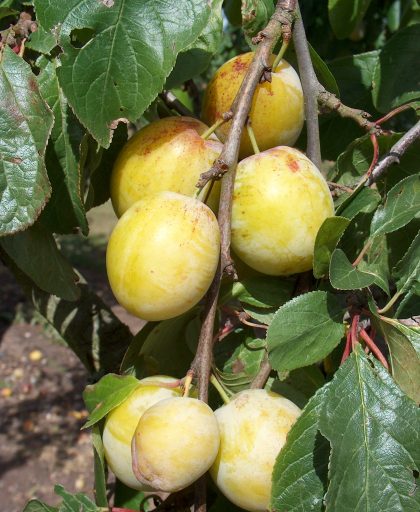
Warwickshire Drooper is a dual purpose variety. The tree has an attractive drooping habit. The fruits are large, yellow with attractive red speckling and a fine flavoured, yellow juicy flesh. Plums can be used for cooking or eating. Self fertile. Transplants suitable for organic production.
Pollination group B, one year Maiden Tree.
Picking time early September.
Carriage is chargeable on all tree orders at a flat rate of £25.00 per order with some surcharges to outer areas. UK delivery only. Unfortunately, the Fruit trees are unable to be delivered to the Channel Islands and the Isle Of Man, due to the risk of introducing fireblight and cost of obtaining buffer zone status.
Please note: Fruit trees are dispatched from November until March.
Warwickshire Drooper is a dual purpose variety. The tree has an attractive drooping habit. The fruits are large, yellow with attractive red speckling and a fine flavoured, yellow juicy flesh. Plums can be used for cooking or eating. Self fertile.
Plums are sent from November until March as bare rooted, one year old trees. All varieties are self fertile unless stated. They need a sheltered position protected from frost. Plum trees are quite hardy but they flower early in the year so if you loose the flower to frost there will not be any fruit. The soil needs to be rich and moisture retentive but not waterlogged. A sunny position will help the fruit to ripen and become sweet. Plums do not store so pick and eat or destone and freeze. Many varieties are dual purpose so as well as being delicious to just eat they can be cooked to make pies, crumbles, jams and chutney.
Prune plums in the summer after cropping, unlike most other top fruit which is pruned in the winter.
A guide to pollination groups.
Most plums are self fertile so do not need a pollinating partner, however they will produce a better crop if a pollinating partner is available. For the few varieties that do require a pollinating partner refer to the pollination group.
Most fruit trees need another tree in the vicinity, in flower at the same time, for pollination. The flowering time is given a pollination group letter A – E. There is some flowering overlap between adjacent letters so an apple in group B can be pollinated, ideally, with another from the same group but can also be pollinated from the group either side, in this example group A or C.
A guide to rootstocks
A guide to planting (It is not advisable to grow plums in containers)
We supply bare-root trees from November until March. Be ready to plant them, you will need a stake, a tree tie and a rabbit guard.
You will have received your trees within a polythene bag and their roots will be damp. You can always redampen by dunking in a tub of water or spraying over with a watering can. Ensure the roots remain damp by keeping within polythene bags as you prepare the site and the planting hole.
Avoid planting in extremely wet conditions or when the ground is frozen. In these cases the trees can be kept temporarily within the polythene bag they came in until conditions improve. If planting is going to be delayed more than a few days trench into some available soil ensuring good soil contact with the roots.
The planting hole
Dig the planting hole a little larger than the root system. A good guide is a square sided hole each side about two spade widths wide and a spit deep. Remove any large stones and vegetation. The hole should be able to comfortably accommodate the roots. Avoid curling the the roots back on themselves. If roots are very long reduce them a little. Fork over the bottom of the hole.
Staking
Staking is advisable except in very sheltered sites. We suggest using a short stake 1.2-1.5m / 4-5′ tall inserted vertically at planting on the windward side. The aim is to hold the roots firm as they establish but allow the upper part of the tree to move in any wind which will strengthen the tree in the longer term.
Once you have dug your hole place the roots within it. Offer up your stake to the tree close to the trunk passing it through a suitable gap in the roots. Release the tree and bang in your stake until firm.
Backfilling
You should aim to plant your tree at the same height as it was planted in the nursery with the graft union clear of soil level and the roots starting to arise at soil level. To assist with this lay a stick or a cane across the hole. Back-fill ensuring no air pockets are left between the roots consolidating the soil as you go along. To do this break down the excavated soil as finely as you can. Return the soil gradually, filtering through the roots. During the process occasionally shake the tree up and down to help further settle the soil around the roots.
Use this shaking process to obtain the correct planting depth against your stick or cane, or by eye, ensuring the roots will all be below soil level. Once the majority of the roots have been covered gently firm the surrounding soil backfilled soil with your foot. Be careful not to overfirm. Continue to backfill until soil level with surrounding ground and gently firm for a final time.
Finish the job by attaching your tree tie. If rabbits are present fit a guard on the same day as planting.
To improve the soil or not?
Generally we say not to improve the soil with compost or manure. The trees have come out of soil so are quite adapted to going straight back into soil. Just plant correctly ensuring as good soil contact with the trees roots as possible. You want to encourage the roots to grow out into the surrounding soil.
Situations where the addition of compost may be sensible include where the soil is very heavy to improve drainage. If the soil is on the alkaline side – in limestone or chalk areas compost will help to acidify the soil. The ideal ph for fruit trees is about 6.5-6.7 – slightly on the acid side of neutral.